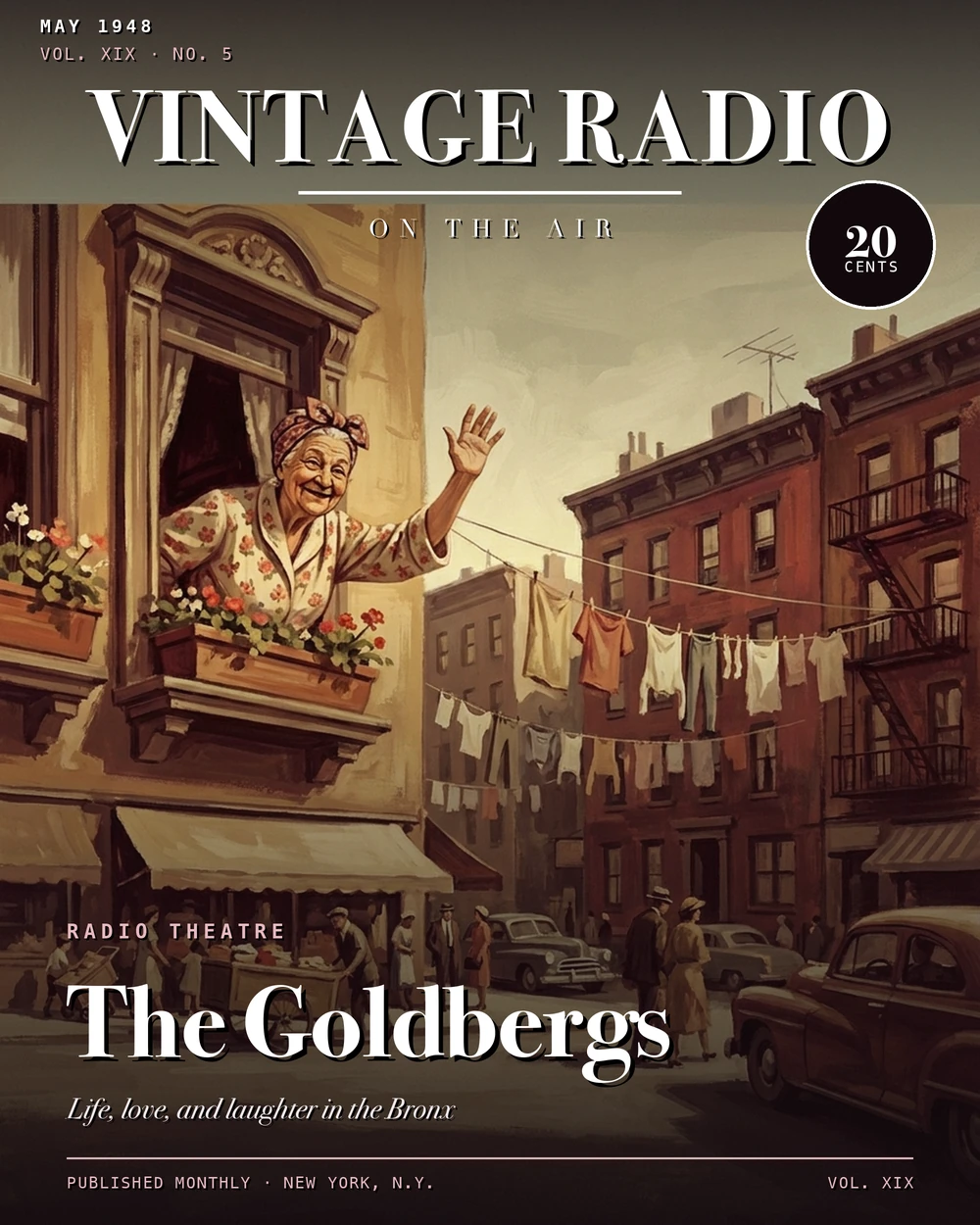
The Goldbergs
The Woman Behind Molly
The Goldbergs began not in a radio studio but in a Catskills resort hotel, where a young Gertrude Berg — born Tillie Edelstein in East Harlem on October 3, 1899 — entertained her father Jacob's guests with comic performance sketches. The characters she developed there, a middle-aged Jewish woman and her family, would eventually become the longest-running Jewish-led series in American broadcast history. In December 1918, while enrolled in a playwriting extension course at Columbia University, she married Lewis Berg, who would become a consulting engineer and who, throughout her career, refused to be photographed with his wife for publicity, feeling it infringed on her success. When Berg finally brought her Goldberg characters to NBC's attention, a fire had recently destroyed the sugar factory where Lewis worked. She wrote the pitch script by hand, and when the NBC executive she met with couldn't read her handwriting, she read it aloud — which both sold the concept and landed her the starring role.
Phillips Carlin, then chief of sustaining shows at the Blue Network, scheduled the program as The Rise of the Goldbergs, and it first aired on November 20, 1929. NBC offered Berg a one-month contract at $75 a week, with the expectation that she would pay the cast herself. Within roughly two years, her salary had climbed to $2,000 per week — this during the height of the Great Depression. By 1936, she had signed a five-year contract with Procter & Gamble worth approximately one million dollars, and by the end of that decade she was reportedly earning $7,500 per week. The financial arc alone tells you something about how the show landed.
Berg's path to the script had included an early audition reading a commercial in Yiddish on WMCA, and a CBS sketch called Effie and Laura that was scheduled and then canceled after a single performance. By the time she brought The Rise of the Goldbergs to NBC, she had been writing and refining her Goldberg family for years. The character name, she explained simply, was chosen "because it sounded right and that was the only reason." The husband was named Jake, after her own father. The children were Sammy and a girl named Rosalie, modeled loosely on her own two children, Cherney and Harriet — both born in the 1920s, and decades later joined in 1952 by two European war orphans the Bergs adopted, a ten-year-old Italian boy and a twelve-year-old French girl.
The Show Itself
The Goldbergs lived at the mythical address 1038 East Tremont Avenue, which Berg later identified as an intersection in the Bronx. Jake was a poor tailor — Berg's original scripts had described him as "a cloak-and-suit operator" — and Molly was his warm, philosophically minded wife who "yoo-hooed" her way through life, dispensing homespun wisdom and somehow keeping the family's world in order. Her one-way conversations up the dumbwaiter with the unheard Mrs. Bloom — always beginning with "Yoooooo-hooooo, Mrs. Bloooo-oooom!" — became one of the show's most durable recurring features. Many of the philosophical lines Molly delivered were ad-libbed by Berg in the moment. Announcer Bud Collyer eventually introduced the character with the words "here she is, folks: that's Molly Goldberg, a woman with a place in every heart and a finger in every pie."
The original four family members — Berg as Molly, James R. Waters as Jake, Alfred Ryder as Sammy, and Roslyn Silber as Rosalie — held their roles for more than 15 years. Menasha Skulnik played Uncle David, who was added to the show after it was already under way. Everett Sloane played Sammy during the late 1930s, and Arnold Stang, who would later become widely known as the voice of the animated cat Top Cat, played the recurring character Seymour Fingerhood. Garson Kanin — later celebrated as a playwright and director — turned up as the recurring character Eli Edwards. The original Jake, before Waters took the role, was Himan Brown, whom Berg recruited after hearing him read newspapers with a Yiddish dialect on WEAF; Brown held the part for approximately six months. The show's theme was Toselli's Serenade, played on organ.
Radio historians Frank Buxton and Bill Owen, writing in The Big Broadcast 1920–1950, described the series — which they classified as a soap opera as much as a comedy — as differing from most other soaps in that its characters "lived through relatively normal situations" and carried identification for a wide segment of listeners. Time magazine described Berg's performance as full of "shrugs, flutters, malapropisms, and a passionate capacity for making something dramatic of the commonplace." Scholar Jeffrey Shandler later argued that Molly's singsong rhythms, inverted syntax, malapropisms, and occasional Yiddish interjections — "nu?", "oy!" — rendered Jewishness "for the most part, a matter of comical speech." The show bore a structural resemblance to One Man's Family in that the children grew up, married, and the parents aged alongside them. Over the full run, the show incorporated more than 200 named characters, though only five — Molly, Jake, Sammy, Rosalie, and Uncle David — sustained it throughout.
Berg as Writer and Producer
Berg was the sole owner of the show and functioned, in the words of those who worked with her, as a benevolent dictator with control over everything down to the sound effects. For authenticity, when a scene was set in the Goldberg kitchen, she broke real eggs into a real frying pan and each cast member rattled their own china. She once gave Roslyn Silber an on-air shampoo when the script called for Molly to wash Rosalie's hair. William Birnie, writing in American Magazine, reported that Berg made James Waters repeat a simple line like "Sammy, you're breaking your father's heart" 17 or 18 times before she was satisfied. Birnie also reported that she once wrote an entirely new script in eight minutes flat after an important cast member failed to appear at the last moment.
Berg wrote nearly all of the radio episodes — variously estimated at more than 5,000 scripts across the run — continuing to write them in pencil throughout the series. During the peak daily-serial period she worked nine-hour days to produce five 12½-minute scripts per week, constructing storylines toward a Friday climax to leave listeners eager for Monday. By her peak years she could write a standard script in half an hour. She was simultaneously writing and starring in two shows per day while also writing the soap opera Kate Hopkins. Four weeks into the original 1929 run, when she fell ill with a sore throat and a substitute played Molly, the station received 11,000 letters of protest — an early measure of how completely listeners had identified her voice with the character. She researched the show by going incognito into the Lower East Side, browsing among tenements, vegetable stands, and pushcarts, and in 1936 she took a Radio Mirror reporter on a tour through Orchard Street to show the wellspring of the material. Reporter Ben Gross of the New York Daily News once encountered her browsing among peddlers on Allen Street during one of these research trips.
The show's cultural scope was broad enough to attract guest performers from outside radio entirely. Metropolitan Opera tenor Jan Peerce was cast by Berg almost annually to sing on Yom Kippur and Passover episodes. Contralto Ernestine Schumann-Heink personally requested an appearance and was written into three episodes. Berg was also not averse to serious subject matter: a 1939 episode depicted Kristallnacht and the Nazi persecution of Jews, including a rock thrown through the family window during a Passover Seder. World War II-era episodes alluded to friends and relatives trying to escape the Holocaust, and when the character Sammy was called up for military service, the episode was broadcast from Pennsylvania Station, using the actor's actual departure on a troop train.
The Network Years
The show's radio run crossed networks several times over more than two decades. It launched on the Blue Network in November 1929, running in 15-minute episodes through May 1931. It then moved to NBC from July 1931 to July 1934, airing six days a week under Pepsodent sponsorship. The show reached a rating of 25 points in 1932 shortly after switching to a serial format, making it one of the highest-rated programs on radio. Between network contracts in 1934, Berg took the cast on a live performance tour rather than let the show go dark. A brief CBS run followed in 1936, then NBC again through the end of 1937 under Oxydol sponsorship. The show returned to CBS in January 1938 and ran there through March 1945, sponsored by Oxydol — its longest single stretch on one network.
During this period the show was also heard simultaneously on WOR, and briefly on NBC as well during the early 1940s. When James Waters died suddenly in 1945, rather than recast the role of Jake, Berg simply had Molly refer to him, writing occasional dialogue in which his replies went unheard. The show went off radio following his death, returning only in 1949 for a final 30-minute weekly CBS run sponsored by General Foods — a format that closely followed the CBS television series, which had premiered on January 10, 1949. For that final radio run, the cast was identical to the television cast: Philip Loeb as Jake, Larry Robinson as Sammy, Arlene McQuade as Rosalie, and Eli Mintz as Uncle David. The radio series ended on June 24, 1950.
Life magazine wrote during the show's peak that for millions of Americans, listening to The Goldbergs "has been a happy ritual akin to slipping on a pair of comfortable old shoes that never seem to wear out." Of the daily 15-minute serial comedies, only Amos 'n' Andy enjoyed a longer radio life.
The Television Years and the Blacklist
The television run of The Goldbergs began on CBS on January 10, 1949, and what happened during it became one of the ugliest episodes in American broadcasting history. Philip Loeb, who played Jake on both the final radio run and the television series, was named as a Communist sympathizer in the anti-Communist pamphlet Red Channels, published June 22, 1950. His suspected associations stemmed from union activities with the Actors' Equity Association and involvement with organizations that had signed petitions in defense of the Soviet government in the 1930s; he consistently denied party membership.
Berg, who owned the television series as she had owned the radio original, refused to fire Loeb. She and Loeb stalled General Foods' demands for over a year. He finally resigned, accepting a settlement estimated at $40,000. When Berg refused to dismiss him, General Foods canceled its sponsorship and CBS dropped the show from its schedule by June 1951. NBC picked it up for the 1952–53 season on the explicit condition that Loeb not appear. Berg gave in but quietly continued to pay Loeb a salary after he left. Philip Loeb, unable to find acting work after his blacklisting, took an overdose of sleeping pills at the Taft Hotel in midtown Manhattan on September 1, 1955. No note was found. He was buried at Mount Sinai Cemetery in Philadelphia. His trajectory was later dramatized in Martin Ritt's 1976 film The Front, with Zero Mostel playing a character closely modeled on Loeb and a screenplay by Loeb's friend Walter Bernstein.
The television series moved through CBS (1949–51), NBC (1952–53), and DuMont (1954) before a syndicated filmed version ran in 1955–56. In that final syndicated version, the family was relocated to the fictional suburb of Haverville — a move critics considered the end of the show, with the widely held view that the Goldbergs "were only the Goldbergs in the Bronx." Berg won the first Emmy Award ever given for Lead Actress in a Television Series, at the 1951 ceremony, in her twentieth year playing Molly. The 39 filmed syndicated episodes survive intact, and most DuMont episodes survive at the UCLA Film and Television Archive, which holds all extant television episodes. The early radio run fared less well: collectors identify the April 13, 1934 NBC broadcast as the earliest known surviving radio episode, and with the possible exception of a single recording, nothing from 1929 to 1937 is known to survive, with very few episodes preserved from before the 1940s. In March 2010, Shout! Factory issued The Goldbergs: The Ultimate Goldbergs, a DVD set collecting all 71 extant television episodes along with 12 radio episodes and the pilot.
What Came After
The Goldbergs expanded into nearly every medium available to it. A tie-in book, The Rise of the Goldbergs, was published in 1931. A newspaper comic strip illustrated by Irwin Hasen ran from June 8, 1944, to December 21, 1945. Berg wrote and starred in the Broadway play Me and Molly in 1948, with Philip Loeb as Jake. A feature-length film, Molly, followed in 1951, co-written by Berg and N. Richard Nash, with actress Barbara Rush making her film debut in the production. The Molly Goldberg Cookbook was published in 1955. Berg's autobiography, Molly and Me, appeared from McGraw-Hill in 1961. Berg's son Cherney, meanwhile, went on to produce and write episodes of the syndicated television series and was the primary writer on her later sitcom Mrs. G. Goes to College.
Berg's stage career didn't slow after the show ended. She won the Tony Award for Best Actress in a Dramatic Play in 1959 for A Majority of One, a play about a Jewish widow and a Japanese widower, co-starring Cedric Hardwicke. She won the Sarah Siddons Award for theatrical work in Chicago in 1961. In 1961 she starred in Mrs. G. Goes to College on CBS alongside Hardwicke, Mary Wickes, and Marion Ross, though the series was canceled after one season. In 1965 she released a spoken-word comedy album, How to Be a Jewish Mother, based on Dan Greenburg's 1964 book; it reached No. 131 on the Billboard Top LPs during a twelve-week chart stay. One unlikely sideline: Berg wrote a composition titled "That Wonderful Someone" that found its way into Patsy Cline's repertoire and appeared on the country singer's 1957 debut album. A Broadway musical adaptation of The Goldbergs, titled Molly and starring Kaye Ballard, directed by Alan Arkin, ran for 68 performances in 1973, seven years after Berg's death.
Not every critic was admiring. In Commentary magazine in April 1954, journalist Morris Friedman argued that Berg as a performer was better than her own material, and that she had remained aloof to changing times while continuing to play a character whose best days were behind her. The scholarly afterlife has been kinder: Glenn D. Smith Jr.'s Something on My Own: Gertrude Berg and American Broadcasting, 1929–1956 (Syracuse University Press, 2007) is a full-length academic biography, and Jennifer Keishin Armstrong's When Women Invented Television (2021) profiles Berg as one of four women who shaped the medium in its earliest years.
Gertrude Berg died of heart failure on September 14, 1966, at Doctors Hospital in Manhattan. She is buried at Clovesville Cemetery in Fleischmanns, New York — the same town in the Catskills where she first invented the Goldbergs to entertain guests at her father's hotel. The Goldbergs was inducted into the Radio Hall of Fame in 1989. Documentary filmmaker Aviva Kempner, director of the 2009 documentary Yoo-Hoo, Mrs. Goldberg, described Berg as being "too early — she was Oprah before there was Oprah." According to a Tablet Magazine assessment from September 2018, there was no other television show with a Jewish character as lead until 1972, and no married Jewish leads again until 2002 — a measure of just how singular what Berg built really was.